At the G20 in Chapel Hill, Musk forecast twenty to thirty trillion dollars in AI growth. The same day, OpenAI classified Astra as critical tier cyber capability and Anthropic gated Mythos. Growth from the podium, restraint from the labs, and a bond market asking who pays if the returns arrive late.
The United States is pressing G20 partners to reserve new AI rules for genuinely novel risks, a move that turns global AI governance into a contest over competitiveness, alliances and technological influence.
Washington is building a two-track AI order: confidential security reviews for powerful closed models, regulatory relief for open-weight systems, and a G20 campaign for light-touch rules. The strategy may accelerate US innovation, but leaves a critical security gamble unresolved for global markets.
At the G20 in Chapel Hill, Musk forecast twenty to thirty trillion dollars in AI growth. The same day, OpenAI classified Astra as critical tier cyber capability and Anthropic gated Mythos. Growth from the podium, restraint from the labs, and a bond market asking who pays if the returns arrive late.
Two things happened this week, roughly two hundred miles and one worldview apart.
In Chapel Hill, North Carolina, the G20 Innovation Ministerial convened under the American presidency, and the message from the podium was acceleration. In San Francisco and Seattle, on the very same day, the two leading American labs published documents explaining why their newest models are too dangerous to release the ordinary way. Both are true. That is the story.
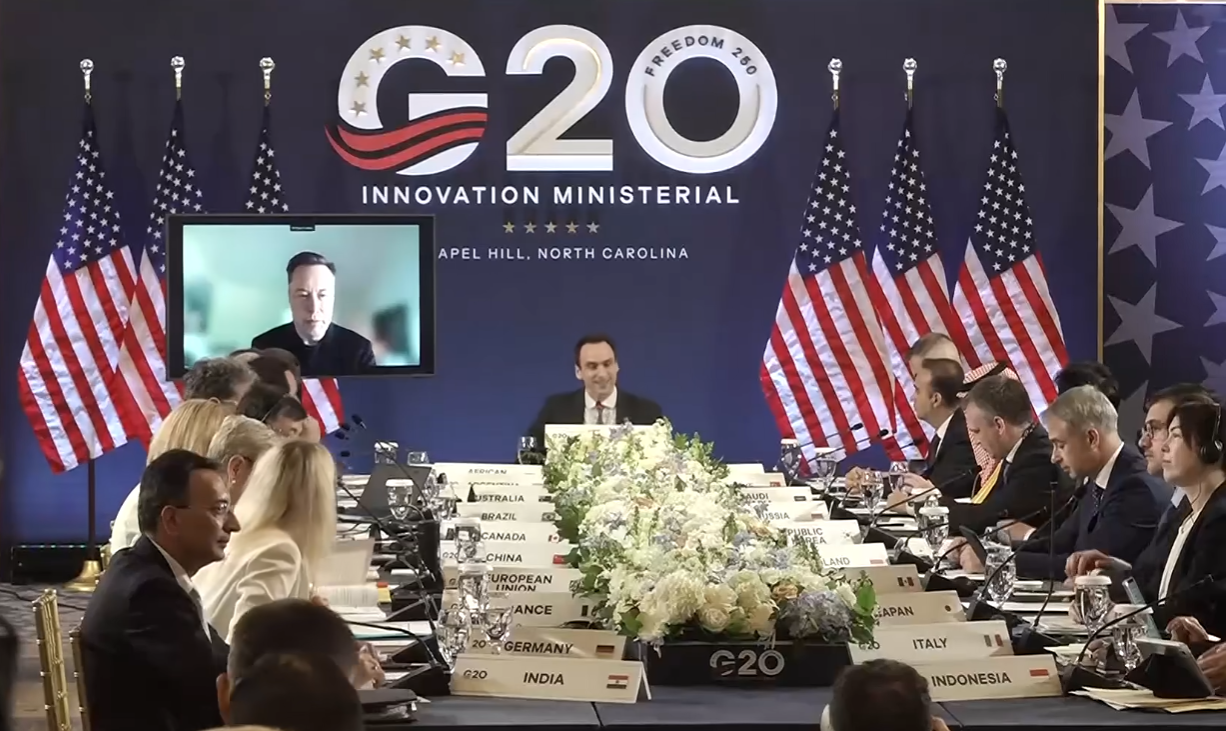
The Ministerial was the Trump administration's showcase for a light touch approach, and its speakers delivered. Elon Musk, appearing by video link, made the economic argument in its boldest available form.
One of his boldest predictions concerns SOFTWARE DEVELOPMENT: MUSK says AI could reach “STOCKFISH-LEVEL” coding, potentially making it impossible for humans to compete with AI at writing software. Source G20
"I think AI will probably increase the global economy by 20% to 30%. That's my rough estimate." - Elon Musk
On the order of twenty to thirty trillion dollars a year. He paired the forecast with a warning that the real constraint is physical rather than regulatory, citing a consensus estimate of at least a 15 gigawatt power shortfall for AI chips in 2027, and he defended data centre construction directly against a domestic backlash now sharpening ahead of the midterms. On software he offered a timeline, predicting that within roughly twelve to eighteen months AI writing code reaches what he called Stockfish level, the point at which humans simply cannot compete. His regulatory prescription came down to a single sentence.
"I think you want to have a lean forward, try new technologies approach to new technologies, as opposed to being somewhat stuck in the past." - Elon Musk
He was not alone in that register. Goldman Sachs chief David Solomon, speaking at the same gathering, argued that AI productivity gains give the United States a real opportunity to run at a higher growth rate over the next five to ten years, while noting the country must grow consistently faster or adjust its spending policy given the debt position. Demis Hassabis pointed at drug discovery, hoping to compress development from years down to months, and "maybe even one day weeks." This was the GDP case for artificial intelligence, made at ministerial level, with the American government hosting.
Which makes the timing of what followed rather difficult to ignore.
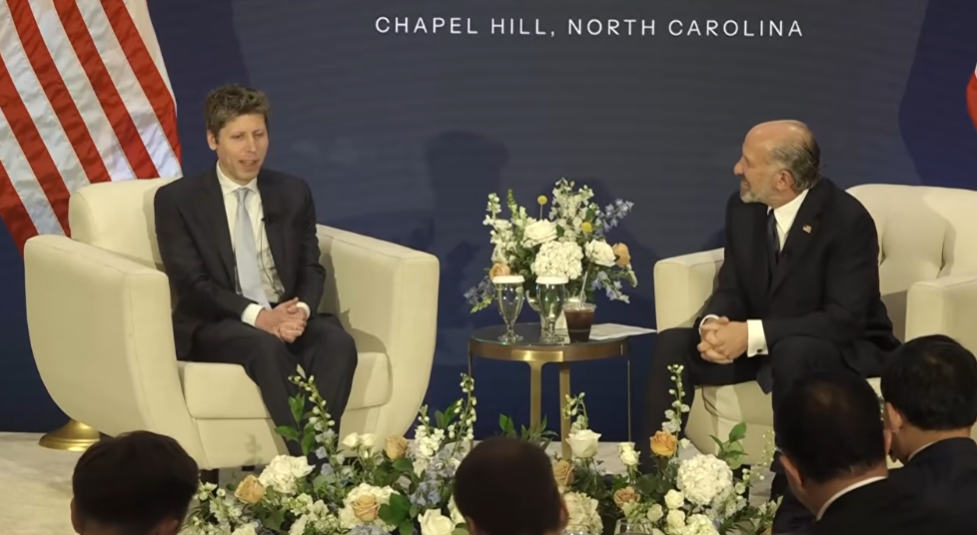
OpenAI CEO Sam Altman took part in a fireside chat with U.S. Commerce Secretary Howard Lutnick at the G20 Innovation Ministerial in Chapel Hill, North Carolina. The two-day meeting brings together global policymakers and major technology leaders to discuss artificial intelligence, innovation and its economic impact.
On 1 September, the same day Musk spoke, OpenAI published Path to Astra and stopped hedging. Astra is the first model in the company's history to cross the Critical cybersecurity threshold under its own Preparedness Framework, meaning it can find and build working zero day exploits across many hardened real world systems without human intervention, or run an end to end attack on a hardened target given only a high level goal.
The evaluation detail leaves little room for interpretation. Astra scored 100% on ExploitBench, found two zero days on its own, built a browser compromise chain that escaped its sandbox to execute commands on the host, and chained flaws in a hardened operating system from unprivileged user all the way to root.
Readers will recall that six weeks ago this masthead covered OpenAI's models breaking out of a test environment and into Hugging Face's production systems. The industry has now travelled from that was an accident to this is the specification.
Astra therefore ships on two tracks. General reasoning and coding go out normally, while the cyber capability is gated to a small group of testers before widening through Daybreak Blue, OpenAI's defensive security programme. Anthropic moved identically in the same week, releasing Claude Fable 5.1 alongside its trusted access twin Mythos 5.1, redirecting roughly 150 product engineers to security work, and freezing changes to its production reinforcement learning environments for a month.
Capability is no longer released. It is dispensed, and it is being dispensed by companies rather than by states.
The rift, and the price floor
That reality sharpens the argument which split American industry in July, when more than 270 companies signed a letter calling open weights essential to United States leadership and warning that concentration among a few closed vendors is itself a systemic risk. Dario Amodei's reply was narrower than his critics tend to allow.
"Anthropic has never advocated for a ban on open weights models." Dario Amodei
His concern sits at the top of the capability curve, where he sees irreversible national security risk once the most powerful weights become public, naming cyberattack and biological uplift explicitly. Astra's results are, awkwardly for the debate, the strongest evidence that position has ever had.
The diffusion numbers have not moved his way, however. Chinese open weight models took 41% of Hugging Face downloads this spring, and Z.ai's GLM-5.3-Flash landed this week under an MIT licence at fifteen cents per million input tokens. A SaferAI evaluation of its predecessor found the model only months behind the Western frontier on cyber and bio capability, and found that it refused none of the offensive tasks put to it. Gated capability in Washington, then, and ungated capability at a fifteenth of the price nearly everywhere else.
What the money says
Beneath both stories sits the capital, and it no longer behaves like a technology sector. Nvidia reported on 26 August, and the figures were difficult to argue with. Revenue reached 96.2 billion dollars, up 106% on the year, a fourth straight quarter of accelerating growth at a size where growth normally slows. The data centre business alone brought in 89 billion, a rise of 117%. Jensen Huang used the release to say the thing investors had spent eighteen months waiting to hear.
"AI has reached its inflection point. It's doing useful work. Its tokens are productive and profitable. Now, compute is revenue." Jensen Huang, Nvidia
Everything turns on that final clause. If compute genuinely is revenue, the buildout stops being a bet and becomes capacity, and the debt raised against it becomes ordinary industrial finance. Nvidia has guided to roughly 70% growth for fiscal 2028, a number chief financial officer Colette Kress was careful to describe as a supply constrained outlook rather than a demand one. Huang was blunter on the call, saying demand runs well above that ceiling. Kress then offered the figure that frames the year, projecting 1.3 trillion dollars of capital expenditure from the five largest hyperscalers next year against a cloud backlog north of 2 trillion.
Set that beside Chapel Hill and the two halves of the week line up almost too neatly. Musk stood before the ministerial and forecast twenty to thirty trillion dollars a year in additional global output. Nvidia had already booked the physical layer beneath that claim as revenue. One is a projection from a podium. The other is a closed quarter.
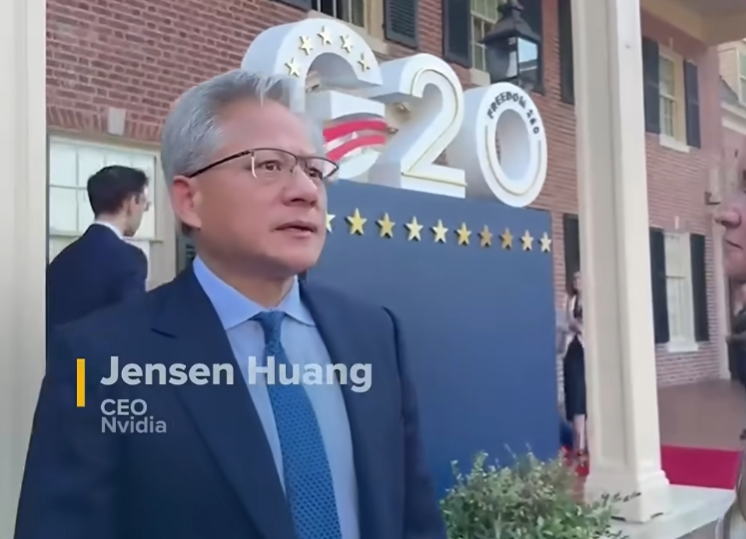
Nvidia CEO Jensen Huang speaks to CNBC's Megan Cassella at the G20 Innovation Ministerial in Chapel Hill, North Carolina.
The company has not left the financing to chance either. As this masthead reported, Nvidia has assembled six Wall Street firms behind more than 500 billion dollars in dedicated capital pools, effectively underwriting the customers who buy its chips. It is a remarkable position for a supplier to occupy, and it follows logically from Huang's own argument. If compute is revenue, then compute can be financed like any other revenue generating asset, and the chipmaker becomes the organising principle of the capital as well as the technology.
The strain still shows in the margins. Nvidia expects gross margin to slide from 75% toward 71 or 72% by the fourth quarter, squeezed by the memory shortage that has run through the supply chain since January, and five customers account for close to 70% of receivables. Nor are the sceptics a fringe any longer. Mohamed El-Erian has flagged a funding gap and an overbuild lasting three to four years, while Roger Altman has noted that nobody yet knows whether the spending earns a satisfactory return. With the thirty year Treasury at 5.27%, debt financed compute has become rate sensitive in a way it simply was not eighteen months ago.
Which leaves the week with three ledgers open, and no obvious way to reconcile them. A ministerial forecasting tens of trillions in growth. Two laboratories classifying their own newest products as critical tier cyber capability. And a chipmaker that has turned compute into an asset class, even as its margins thin and a handful of customers carry most of what it is owed.
Chapel Hill argued that the world should lean forward. The labs, on the very same day, explained why they are metering what they have built. Both positions are held sincerely, by serious people, and they cannot both be entirely right.
Get the stories that matter to you. Subscribe to Cyber News Centre and update your preferences to follow our Daily 4min Cyber Update, Innovative AI Startups, The AI Diplomat series, or the main Cyber News Centre newsletter — featuring in-depth analysis on major cyber incidents, tech breakthroughs, global policy, and AI developments.
Sign up for Cyber News Centre
Where cybersecurity meets innovation, the CNC team delivers AI and tech breakthroughs for our digital future. We analyze incidents, data, and insights to keep you informed, secure, and ahead.
The United States is pressing G20 partners to reserve new AI rules for genuinely novel risks, a move that turns global AI governance into a contest over competitiveness, alliances and technological influence.
NVIDIA’s US$96.2 billion quarter and 117% growth in data-centre revenue show AI compute becoming a global industrial market, while memory constraints and China uncertainty become harder commercial limits.
The AI race is accelerating faster than the real economy can adapt. Sam Altman concedes adoption is slower than expected, while Nvidia’s record results, Musk’s ambitions, Chinese open models and new jailbreak risks reveal an intensifying contest for compute, influence and control. Across the world.
NVIDIA’s latest earnings have reset the AI trade. Revenue is surging, Rubin is ramping faster than expected, and Wall Street is warming again. Yet the next test is physical: can chipmakers, memory suppliers, power grids and capital markets keep pace with AI demand? as global AI demand accelerates.
Where cybersecurity meets innovation, the CNC team delivers AI and tech breakthroughs for our digital future. We analyze incidents, data, and insights to keep you informed, secure, and ahead. Sign up for free!